Not a product walkthrough. We’ll work on a real issue you’re dealing with right now.
A Tuesday morning. A real engineering team. Three days from a release.
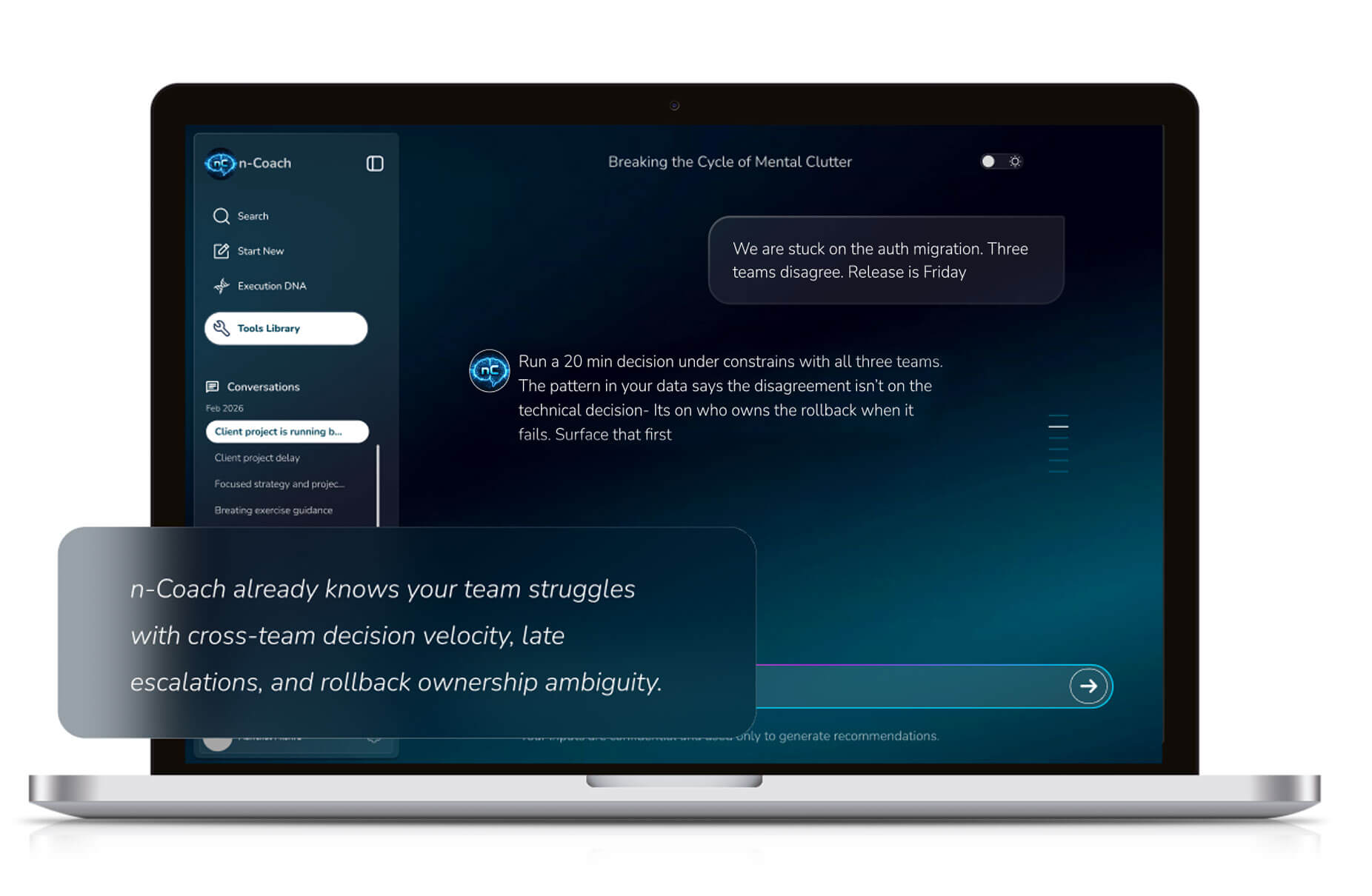
Your engineering team is three days from a release.
The auth migration is blocked.
Product, Security, & DevOps disagree on the rollback plan.
The decision has been stalled for nine days.
You schedule the Decide Under Constraints for 2 p.m. All three teams join. Within minutes, the real blocker surfaces exactly where n-Coach predicted: rollback ownership. By 2:24 p.m., ownership is assigned, the decision is made, and the auth migration ships Wednesday.
The release ships on time. Your team handles the same friction faster. The system gets sharper.
Knew your team’s pattern before the issue arose.
Personalised the recommendation because of your DNA, your history, and the specific issue.
Gave you a tool that fits inside the meeting that needed to happen anyway.
updated your team’s pattern, so next time is sharper than this time.
Nobody else does this. That’s the moat.
Three weeks of “we’re really busy.” One snapshot that tells you what’s actually slowing your team.
An 8-12 minute instrument that maps how your delivery is working today — across people, teams, and the friction patterns that repeat.
An instant on-screen snapshot. A detailed report by email. A starting point for n-Coach.
Periodic. Like a system check. Run it once at start, then quarterly — or whenever delivery feels off.
Project 15 days behind, no idea how to make up the time? Ask. Get a tool that fits your team’s pattern.
The intelligence layer at the centre. An AI system trained on delivery patterns, plugged into your DNA results and the issues you bring it.
Personalised recommendations — informed by your DNA, your team’s history, and what’s worked for similar situations.
User-triggered. You decide what to discuss. It’s not watching your work — it’s responding when you want help.
The 60-minute meeting that ends in nothing? Run a 15-minute Decision Trace inside it. Decision made.
A library of short, sharp tools you can run duringlive work — brainstorms, reviews, decisionmoments, planning sessions. In the work, notadjacent to it.
Structured formats: facilitator script, time-box,prompts. Run inside your existing meetings.
Both digital and in-person. Some tools run on screen, some run in a room. Same structure either way.
The friction is bigger than your team can handle alone. A seniorpractitioner walks in, runs the session, leaves a plan.
Expert-led sessions applied to your real work —not theoretical training. Used when an issue isbigger than the team can resolve themselves.
A senior practitioner runs the session with your team. Everyone leaves with a next-week plan.
Often the entry point for leaders who want to test the approach on one hard problem before going further.
3:42 p.m. WEDNESDAY
You’re a senior data analyst. The recommendation is due Friday, but the data supports two reasonable answers. The problem isn’t analysis — it’s conviction.
3:42 p.m. WEDNESDAY
Your DNA already flags decision confidence as a recurring friction point: high rigour, low conviction. Similar decisions have stalled twice before.
Its recommendation:
“Run a 25-minute Idea Sprint.
If you had to bet your own bonus on one answer, which would it be?”
The pattern is clear: you already know the answer. You just haven’t committed to it yet.
4:08 p.m.
You run the Idea Sprint solo. By 4:32 p.m., you have a clear recommendation and three reasons behind it.
They show what’s late.
They don’t tell you why.
They don’t learn.
It teaches frameworks.
It doesn’t show up at
11:14 a.m. on Tuesday.
It diagnoses.
It leaves a deck.
It doesn’t compound.
Diagnosis, in-the-moment
intervention, escalation,
continuous learning in one system.
Five things mind-n delivers today. Three we’re building openly.
Nothing on this list comes from any single category.
Or book a working session to discuss your case